

Connecting Averages

 1 out of 3
The number in the square is the mean of the four numbers surrounding it. Can you find the missing numbers?
Problem
This problem builds on Hunting for Averages.
Hunting for Averages printable sheet
Connecting Averages printable sheet
In these challenges, the number in each square is the average (mean) of the four numbers surrounding it.
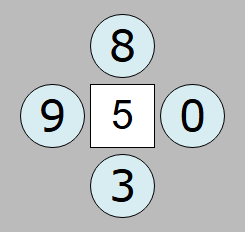
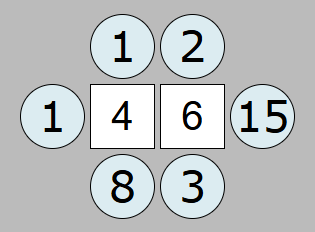
Can you explain why the numbers 5, 4 and 6 belong in the squares in the two examples above?
The challenge, in the interactivity below, is to find the missing number(s). All numbers are whole numbers.
You can click on the purple cog to change the grid size.
Can you create a similar problem for someone else to solve (with whole number solutions)?
Thank you to Silvia, who first worked on this problem with us.
Teachers' Resources
Using NRICH Tasks Richly describes ways in which teachers and learners can work with NRICH tasks in the classroom.
Why do this problem?
This problem offers opportunities for students to apply what they know about finding the mean. As students move towards working systematically, they are challenged to adapt and extend their approaches to suit the more complex problems.
Key ideas
There are multiple ways of approaching this problem. Learners might take a numerical approach, developing a systematic form of trial and improvement, recognising that the four numbers surrounding each square must add to a multiple of 4.
Some might prefer to use algebra, writing letters to represent all or some of the unknowns and creating algebraic statements using the information they know.
Key questions
How could you calculate the mean of four numbers?
If the mean of four numbers is a whole number, what can you say about the total of these numbers?
What is the smallest value this mean could be? (Remember that the means are whole numbers.)
For students who are using algebraic approaches:
If $A$ is the mean of the four numbers surrounding it, what is the total of those four numbers?
Possible support
It is essential that students have a good understanding of the concept of mean average. This Primary webinar recording offers some guidance on how to introduce the concept.
If students take an algebraic approach, they may find it difficult to set up equations involving the unknowns. This Secondary webinar recording offers guidance on how these problems can be approached algebraically.
Possible extension
The Settings menu (purple cog) offers a whole range of levels, including the 3x3 grid, which is likely to challenge even the highest attainers in the class!
Students who are confident with using an algebraic approach may be tempted to put a different letter in each square of the grid. They might like to find a simpler algebraic approach, which uses as few unknowns as possible.
An alternative way to extend the problem is to ask students to create a similar problem for someone else to solve (with whole number solutions).
Algebraic Averages offers two levels of challenge:
Level 1 requires students to solve equations with one unknown
Level 2 requires students to solve simultaneous equations with two unknowns
Submit a solution
What we like to see
We have written an article on what we are looking for when we decide which solutions to publish.
You can share your work with us by typing into the form above or uploading a file.
What can I upload?
- Word documents
- PDF files
- Excel spreadsheets
- Images, including screenshots or photos of written work
If your work is on another app
You can also send us a link to your work on:
- Youtube/Vimeo
- Google Docs
- Sharepoint/Office 365
- Anywhere sensible on the internet!
Please make sure you have set the permissions so that we can access your work.
How we use your information
By uploading your solution here you are giving us permission to publish your work, either as a whole or edited extracts, on the NRICH website and in associated educational materials for students and teachers, at our discretion.
For our full terms of use regarding submitted solutions and user contributions please see https://nrich.maths.org/terms.
Your information (first name, school name etc) is optional. If supplied, it may be used for attribution purposes only if your work is published on the website. Data that you supply on this form (e.g. age if supplied, location if supplied) may also be anonymised and used for evaluation and reporting.
For more information about the University's policies and procedures on handling personal information, and your rights under data protection legislation, please see https://www.information-compliance.admin.cam.ac.uk/data-protection/general-data.