

Roaming Rhombus


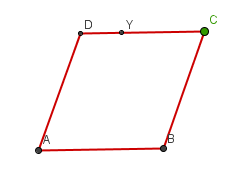
We have four rods of equal lengths hinged at their endpoints to form a rhombus ABCD. Keeping AB fixed we allow CD to take all possible positions in the plane. What is the locus (or path) of the point D?
Problem
Four rods of equal lengths are hinged at their endpoints to form a rhombus ABCD.
Student Solutions
Well done Luke and Daniel from year 9 together with Nicholas and Luke from year 7 of Clevedon Community School who sent in the following solution.
The locus of corner D will be a circle with a radius equal to AD, whose centre is A. The locus of the point Y will be a circle with a radius equal to AD, and a centre on AB one third of the way along from A to B.
Can you see the reason for this? The locus of Y is a circle. If you imagine a line joining Y to the centre Z of this circle then DYZA is a parallelogram so ZY = AD and AZ=DY.