

Polydron
Age
7 to 11
Challenge level


This activity investigates how you might make squares and pentominoes from Polydron.
Problem
Image
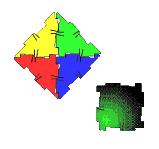
| Do you have any Polydron in your school? Here are some questions about the square Polydron. You can see in the picture that a square can be made in two different ways.
|
Polydron is great for connecting and folding pieces together.
| |
Teachers' Resources
Using NRICH Tasks Richly describes ways in which teachers and learners can work with NRICH tasks in the classroom.
Why do this problem?
This activity can be a good start for exploring the special properties of shapes. Children benefit from lots of informal play with linking shapes such as Polydron, during which time they conceptualise the different characteristics of 2-d shapes and visualise how they might fold up to make 3-d shapes. This visualising is a very important aspect of being a mathematician.
Possible approach
Ask the children to make some squares using Polydron.
What is the same/different about them?
You could bring in the language of similarity - all squares are the same shape but may be different sizes. In what way might we say one square is 'bigger ' than another?
The pentomino activity is not a new one, but using Polydron allows children to try lots of examples. If they keep to the same colours then they can be encouraged to work systematically. They could record their work on squared paper, or you could take photographs of the pentominoes and make a display which could be sorted according to whether they fold up into a lidless box or not. Alternatively, other criteria could be used to sort.
What is the same/different about them?
You could bring in the language of similarity - all squares are the same shape but may be different sizes. In what way might we say one square is 'bigger ' than another?
The pentomino activity is not a new one, but using Polydron allows children to try lots of examples. If they keep to the same colours then they can be encouraged to work systematically. They could record their work on squared paper, or you could take photographs of the pentominoes and make a display which could be sorted according to whether they fold up into a lidless box or not. Alternatively, other criteria could be used to sort.
Key questions
What can you tell me about the square polydrons and the triangular polydrons?
What is the same about them? What is different?
What could 'bigger' mean?
Before you fold them up, can you tell what 3-d shape they will make?
What is the same about them? What is different?
What could 'bigger' mean?
Before you fold them up, can you tell what 3-d shape they will make?
Possible extension
What if you had six squares joined together (hexominoes)?
Can you use what you found out about pentominoes to find some hexominoes that fold up into a box with a lid?
Can you use what you found out about pentominoes to find some hexominoes that fold up into a box with a lid?
Possible support
This is a 'low threshold high ceiling' task in that all of the children in a class will be able to begin the activities, provising they have some moderate degree of fine motor skill.