Win or Lose?
A gambler bets half the money in his pocket on the toss of a coin, winning an equal amount for a head and losing his money if the result is a tail. After 2n plays he has won exactly n times. Has he more money than he started with?

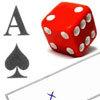
A counter is placed in the bottom right hand corner of a grid. You toss a coin and move the star according to the following rules: ... What is the probability that you end up in the top left-hand corner of the grid?
How could you compare different situations where something random happens? What sort of things might be the same? What might be different?
A man went to Monte Carlo to try and make his fortune. Is his strategy a winning one?
You have two bags, four red balls and four white balls. You must put all the balls in the bags although you are allowed to have one bag empty. How should you distribute the balls between the two bags so as to make the probability of choosing a red ball as small as possible and what will the probability be in that case?
To win on a scratch card you have to uncover three numbers that add up to more than fifteen. What is the probability of winning a prize?
Heads or Tails - the prize doubles until you win it. How much would you pay to play?
Some relationships are transitive, such as 'if A>B and B>C then it follows that A>C', but some are not. In a voting system, if A beats B and B beats C should we expect A to beat C?
A player has probability 0.4 of winning a single game. What is his probability of winning a 'best of 15 games' tournament?
A bag contains red and blue balls. You are told the probabilities of drawing certain combinations of balls. Find how many red and how many blue balls there are in the bag.